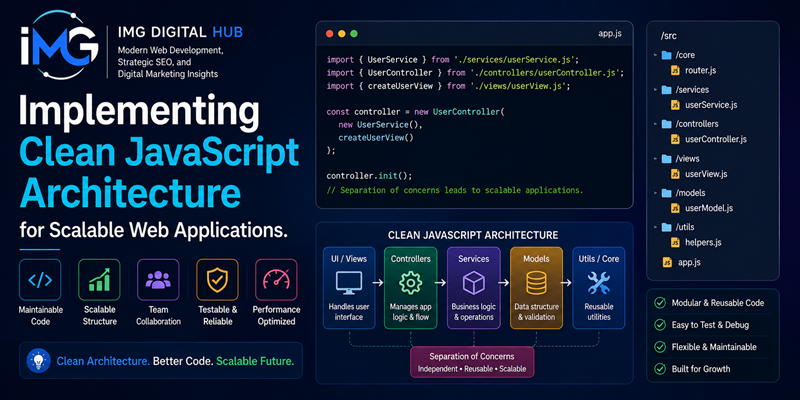
Implementing Clean JavaScript Architecture for Scalable Web Applications – Web development has evolved dramatically, transforming client-side JavaScript from simple interactive scripts into complex software applications. As web applications grow in feature density and user traffic, maintaining unorganized codebases becomes increasingly challenging. Front-end developers frequently face fragile state management, tight code coupling, and technical debt.
Implementing Clean JavaScript Architecture for Scalable Web Applications
Implementing clean architecture in JavaScript provides a structured solution to these engineering hurdles. Clean architecture separates core business logic from framework tools, user interface elements, and third-party APIs. Consequently, development teams can build scalable, maintainable, and testable web applications that accommodate future business needs smoothly.
Core Principles of Clean Architecture in JavaScript
Clean architecture relies on fundamental software engineering principles adapted specifically for client-side environments. The main objective is creating a system where application business rules remain isolated from external software dependencies.
Separation of Concerns
Separation of concerns dictates that each software module should handle a single, distinct responsibility. In unarchitected JavaScript applications, developers often mix API fetching, DOM manipulation, and data transformation within single files. Separating these concerns into dedicated software layers prevents cascading bugs and stabilizes the codebase.
The Dependency Inversion Principle
High-level business policies should not depend directly on low-level implementation details. Instead, both layers must depend on abstract interfaces. For instance, core application logic should remain unconcerned whether user data originates from a REST API, GraphQL endpoint, or browser storage. Passing data adapters into application modules keeps core rules completely independent of external technical choices.
Structuring Architectural Layers in JavaScript
A clean JavaScript application organizes code into distinct, concentric layers governed by strict dependency rules. Outer layers can depend on inner layers, but inner layers must remain completely unaware of outer implementations.
1. The Domain Layer (Core Business Rules)
The domain layer forms the innermost center of your application architecture. It contains primary business entities, domain models, and core validation logic. Crucially, this layer contains zero references to UI frameworks like React or Vue, browser DOM APIs, or HTTP client libraries.
2. The Application Layer (Use Cases)
The application layer encapsulates specific application workflows and use cases. It orchestrates data flow between domain entities and infrastructure services. For example, executing a user subscription workflow involves fetching user profiles, validating business criteria, and triggering payment gateways without managing specific UI rendering details.
3. The Infrastructure and UI Layer
The outermost layer houses user interface components, framework bindings, routing configurations, and HTTP adapters. Because this layer interacts with inner layers through abstract interfaces, developers can replace UI frameworks or network libraries without disrupting core application logic.
Managing State and Side Effects in Scalable Applications
State management frequently represents a major source of complexity in growing front-end codebases. Without clear architectural boundaries, state updates trigger unpredictable side effects across multiple UI components.
To maintain predictability, clean JavaScript architecture enforces unidirectional data flow. User interface components dispatch user actions, which pass through application use cases, update domain models, and flow back to render modified interfaces. Furthermore, side effects, such as network requests or browser storage operations, remain isolated inside dedicated service adapters. This structural isolation prevents race conditions and simplifies debugging across complex user flows.
Key Architectural Practices for Long-Term Scalability
Building scalable web software requires pairing clean structural patterns with disciplined engineering practices.
Modularization with ES Modules
Developers should divide large applications into small, single-purpose ES modules. Modern JavaScript module systems allow engineering teams to encapsulate private implementation details while exposing clean, explicit public interfaces using export statements.
Decoupled Automated Testing
Isolating business rules from UI components and network layers enables efficient automated testing. Testing pure domain functions requires no complex mock servers or browser DOM simulation tools. Consequently, unit test suites execute quickly, giving developers immediate feedback during continuous integration cycles. The Evolution of Web Architecture: From Domain Setup to Scalable Web Applications
Summary
Scaling modern web applications requires deliberate architectural planning. Implementing clean JavaScript architecture isolates business rules from UI frameworks, external APIs, and browser dependencies. By establishing clear structural layers, enforcing dependency inversion, and maintaining unidirectional data flow, engineering teams build resilient applications. Ultimately, clean architecture reduces technical debt, simplifies testing, and guarantees long-term platform scalability.