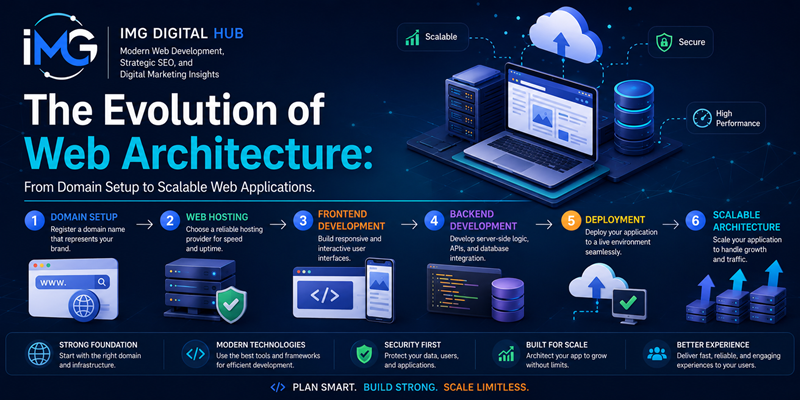
The Evolution of Web Architecture: From Domain Setup to Scalable Web Applications – The digital ecosystem has undergone a massive transformation over the past three decades. In the early days of the world wide web, hosting a website involved deploying basic static HTML pages on a single, local server. Today, enterprise platforms handle millions of concurrent users across globally distributed network infrastructures.
The Evolution of Web Architecture: From Domain Setup to Scalable Web Applications
Understanding the evolution of web architecture helps software engineers, systems administrators, and business leaders design resilient, scalable, and high-performance digital systems.
The Foundation: Domain Infrastructure and DNS Resolution
Every web architecture journey begins at the networking layer with domain registration and system configuration. Before any application server can process user requests, the global internet must map human-readable web addresses to numeric IP addresses. This fundamental routing process relies entirely on the Domain Name System (DNS).
Setting up a robust digital platform requires securing a clean digital identity and configuring domain routing parameters correctly. When establishing new web projects, leveraging reliable domain management providers like MPO GAME ensures essential DNS management tools, allowing systems administrators to configure A records, CNAMEs, and MX routing seamlessly. Proper DNS configuration serves as the foundational doorway to any modern web application, ensuring incoming traffic routes reliably to the correct infrastructure.
The Monolithic Era and Traditional Hosting
During the late 1990s and early 2000s, traditional web applications relied heavily on monolithic architectural models. In a typical monolithic setup, such as the classic LAMP stack (Linux, Apache, MySQL, PHP), all application components resided on a single virtual or physical server.
While monolithic architectures offered operational simplicity for small websites, they faced severe scalability limitations:
-
Single Point of Failure: If the database or web server crashed, the entire application became unavailable instantly.
-
Vertical Scaling Limits: Increasing capacity required upgrading physical hardware specifications, such as RAM and CPU cores, which quickly reached physical and financial boundaries.
-
Resource Contention: Heavy database queries directly degraded web server responsiveness, creating systemic performance bottlenecks.
Transitioning to Multi-Tier and Microservices Architecture
To overcome monolithic scaling limitations, software architects separated monolithic applications into distinct operational layers. The emergence of multi-tier architecture separated presentation layers, application business logic, and database management systems onto independent dedicated servers.
Furthermore, the adoption of load balancers enabled horizontal scaling. Instead of upgrading a single server, network administrators deployed multiple web server instances behind a load balancer. The load balancer distributed incoming HTTP requests evenly across available instances. Consequently, if one instance failed, secondary servers continued processing user requests without downtime.
Eventually, complex enterprise systems evolved further into microservices architecture. Instead of maintaining a single, massive codebase, microservices break applications down into small, loosely coupled services communicating via lightweight APIs. Each service manages its own database and scales independently according to demand.
Cloud-Native Scaling, CDNs, and Edge Computing
Modern web applications operate in cloud-native environments powered by virtualization, containerization, and edge infrastructure. Technologies like Docker and Kubernetes allow development teams to package application code alongside required dependencies, ensuring consistent execution across distributed cloud environments.
Moreover, content delivery networks (CDNs) and edge computing platforms have redefined web performance standards. CDNs cache static assets, such as images, stylesheets, and compiled JavaScript files, across geographically distributed point-of-presence (PoP) servers. As a result, users download assets from servers located closest to their physical location, significantly reducing latency.
Today, serverless computing allows developers to deploy event-driven functions without managing underlying server instances. Cloud providers automatically provision computing resources instantly based on incoming traffic spikes, delivering true elastic scaling.
Summary
The evolution of web architecture reflects a continuous shift toward greater modularity, fault tolerance, and global scalability. From basic domain registration and single-server hosting to distributed microservices and edge networks, modern web infrastructure prioritizes high availability and user experience. By understanding these architectural milestones, developers can build scalable, modern web systems designed to accommodate future digital growth.