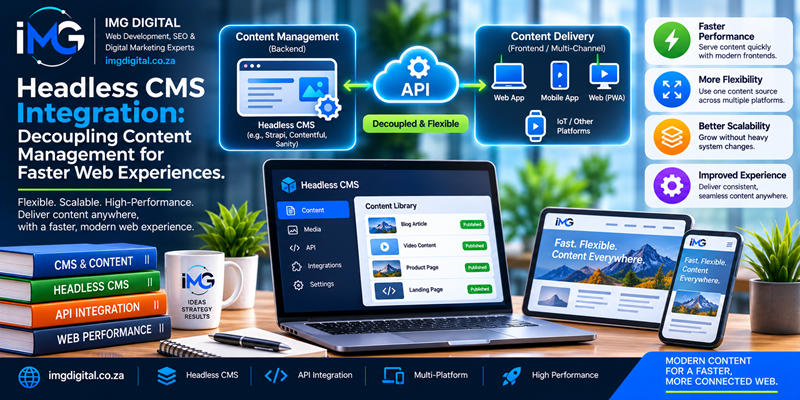
Headless CMS Integration: Decoupling Content Management for Faster Web Experiences – Modern web development demands speed, flexibility, and seamless multi-channel content delivery. In the past, enterprise websites relied almost exclusively on traditional monolithic Content Management Systems (CMS). Specifically, these legacy platforms coupled backend database management directly with frontend visual rendering templates inside a single codebase.
Headless CMS Integration: Decoupling Content Management for Faster Web Experiences
However, monolithic structures introduce severe performance bottlenecks, security vulnerabilities, and code maintainability challenges. As a result, modern engineering teams are shifting toward decoupled architecture. Specifically, a Headless CMS integration separates the content repository from the presentation layer using application programming interfaces (APIs). Therefore, this comprehensive guide explores how decoupling content management unlocks faster web experiences and accelerates digital scalability.
Understanding the Shift from Monolithic to Decoupled CMS
To appreciate the architectural advantages of a Headless CMS, developers must examine how content delivery mechanics have evolved. In traditional platforms, every page request triggers server-side database queries, template execution, and dynamic HTML rendering simultaneously. Consequently, high visitor traffic frequently causes server strain, resulting in elevated loading times.
Conversely, a Headless CMS operates strictly as a backend content repository. Because the system lacks a built-in frontend template layer, content creators manage text, images, and media without worrying about UI styling. Meanwhile, frontend developers use modern frameworks—such as Next.js, React, or Vue—to query content via GraphQL or RESTful APIs. By separating content creation from frontend code execution, engineering teams gain absolute freedom over visual presentation. As a result, applications achieve superior rendering efficiency across mobile devices, web browsers, and IoT interfaces.
Engineering Performance Advantages with API-Driven Content
Decoupling content management yields substantial technical benefits for site speed and Core Web Vitals optimization. Below, key performance mechanics illustrate why modern applications leverage Headless architectures. Serverless Web Architecture: Optimizing Performance and Cost for Modern Web Applications
1. Static Site Generation and Edge Caching
When paired with modern frontend frameworks, a Headless CMS enables Static Site Generation (SSG) or Incremental Static Regeneration (ISR). Instead of querying databases on every user visit, the system pre-renders HTML pages during build cycles. Furthermore, these static assets deploy directly across global Content Delivery Networks (CDNs). Consequently, users load pages almost instantly from local edge servers, achieving exceptional Largest Contentful Paint (LCP) scores.
2. Eliminating Database Bottlenecks
In addition, separating presentation logic prevents database lockups during traffic spikes. Because client browsers fetch pre-rendered assets or cached API responses, the backend database remains protected from direct user traffic. As a result, web applications maintain high stability during major product launches or viral marketing campaigns.
Architectural Comparison: Legacy CMS vs. Headless Integration
Evaluating structural differences highlights how decoupling content architecture modernizes software engineering workflows.
| Performance Vector | Legacy Monolithic CMS | Headless CMS Integration |
| Content Delivery | Server-side template rendering | API-driven static & dynamic hydration |
| Frontend Flexibility | Restricted to CMS-specific theme engines | Unlimited choice of modern JS frameworks |
| Security Surface | Vulnerable backend exposed to web traffic | Isolated backend protected behind APIs |
| Omnichannel Reach | Primarily web browser templates | Simultaneously serves web, mobile, & IoT |
On one hand, legacy platforms lock development teams into proprietary templating languages. On the other hand, Headless integrations empower teams to adopt cutting-edge frontend tools while delivering content across multiple digital channels effortlessly.
Best Practices for Executing a Seamless Headless Integration
Implementing a Headless CMS architecture successfully requires disciplined API design, structured content modeling, and robust security protocols.
-
Design Granular Content Schemas: First, create modular, reusable content models rather than unstructured blob fields. By defining explicit fields for headlines, authors, and component blocks, frontend applications query exact data payloads without receiving bloat.
-
Optimize API Query Payload Sizes: Second, leverage GraphQL over standard REST endpoints where appropriate. Because GraphQL allows frontend components to request only specific attributes, network payload sizes decrease significantly. Consequently, mobile page loading speeds improve.
-
Implement Webhooks for Instant Cache Invalidation: Third, configure automated webhooks between your Headless CMS and frontend deployment platforms. When an editor updates content, webhooks trigger instant background rebuilds. Therefore, visitors view fresh information without sacrificing static site performance.
Summary
In conclusion, Headless CMS integration represents a major evolution in web architecture and content infrastructure. By decoupling backend content management from frontend presentation layers, development teams build faster, highly scalable, and secure digital platforms. Furthermore, leveraging static site generation and API-driven delivery ensures web applications meet modern Core Web Vitals performance benchmarks. Ultimately, adopting a Headless CMS architecture guarantees that your digital enterprise delivers superior user experiences, scales effortlessly across omnichannel touchpoints, and maintains a distinct technical advantage.