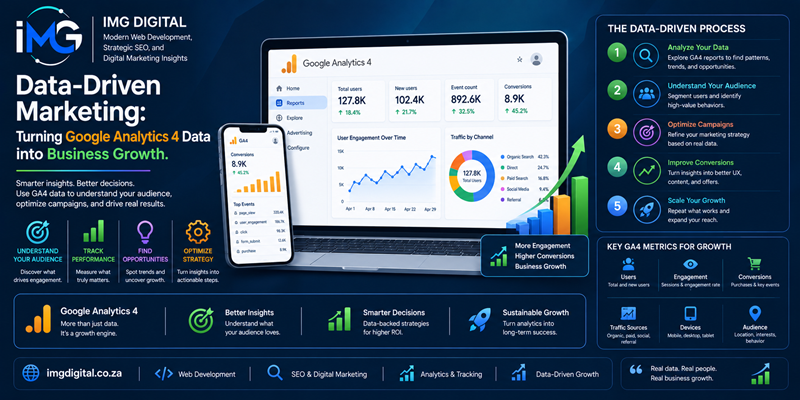
Data-Driven Marketing: Turning Google Analytics 4 Data into Business Growth – Modern marketing strategies have shifted fundamentally from intuition-based creative decisions toward evidence-based strategies. In the past, organizations allocated significant budgets based on broad audience assumptions and static reporting models. However, modern consumer journeys are complex, multi-touch, and highly dynamic.
Data-Driven Marketing: Turning Google Analytics 4 Data into Business Growth
As a result, businesses that rely solely on surface-level metrics risk misallocating resources and missing high-value conversion opportunities. Fortunately, Google Analytics 4 (GA4) provides an advanced event-based framework designed to capture granular user interactions. Specifically, leverage data-driven marketing by converting raw GA4 analytics into actionable growth strategies. Therefore, this comprehensive guide explores how organizations can transform GA4 data into measurable business performance.
Transitioning from Surface Metrics to Growth-Oriented Insights
To build an effective data-driven strategy, organizations must distinguish between superficial vanity metrics and actionable performance indicators. Historically, teams evaluated digital success through simple pageviews, total sessions, or arbitrary follower counts. Consequently, marketing campaigns often appeared successful on paper while failing to deliver bottom-line revenue growth.
Conversely, GA4 structures data around an event-based model, focusing on user engagement, retention, and lifetime value. By analyzing metrics like user engagement rate, key event conversion paths, and predictive lifetime value (LTV), growth marketers evaluate true campaign profitability. Furthermore, tracking complete user lifecycles allows businesses to identify high-value customer segments. As a result, marketing teams refine acquisition strategies to focus on channels that generate sustained ROI rather than short-term impressions.
Utilizing GA4 Features for Strategic Decision-Making
Extracting actionable business value from GA4 requires leveraging its advanced reporting and machine-learning capabilities. Below, three strategic techniques illustrate how to translate raw data into business expansion. GA4 Custom Event Tracking: Measuring Specific User Actions and Conversions
1. Analyzing Conversion Paths and Multi-Touch Attribution
Modern consumers rarely convert during their initial interaction with a brand. Instead, they interact across multiple touchpoints—including organic search, social media ads, email newsletters, and direct website visits. If an organization uses a simplistic first-click or last-click attribution model, middle-funnel channels appear underperforming. However, GA4 utilizes data-driven attribution models powered by machine learning. Specifically, this framework assigns conversion credit across all marketing interactions based on their statistical impact. Consequently, marketers reallocate budgets toward touchpoints that truly drive decisions.
2. Segmenting Audiences for Targeted Acquisition
While aggregate website traffic offers broad trends, actionable insights emerge from granular audience segmentation. Using GA4 Custom Explorations, marketers create distinct user segments based on behavioral triggers, device types, or geographical locations. For example, segmenting users who frequently view pricing pages without completing lead forms allows teams to launch targeted remarketing campaigns. Furthermore, GA4 integrates seamlessly with Google Ads, enabling automated predictive audiences—such as users likely to churn or make a purchase within seven days. As a result, ad spending becomes far more precise.
3. Optimizing User Journeys with Funnel Exploration Reports
Identifying drop-off points within conversion paths is essential for Conversion Rate Optimization (CRO). Through GA4 Funnel Exploration reports, growth teams visualize exact step-by-step user journeys across signup forms, checkout processes, or content funnels. When data reveals a significant drop-off rate at a specific step, UX designers can isolate friction points instantly. Consequently, addressing technical hurdles or simplifying form fields restores conversion flow, directly increasing revenue yield.
Aligning GA4 Analytics with Core Business Objectives
Data collection serves no purpose if insights remain isolated within marketing departments. Therefore, successful organizations establish clear operational alignment between GA4 reporting and overarching business goals.
-
Map KPIs to Revenue Targets: Every custom event and key event tracked in GA4 must correlate directly with business performance. Specifically, track lead acquisition, pipeline value, and customer acquisition cost (CAC) alongside raw traffic metrics.
-
Foster a Culture of Continuous Experimentation: Use GA4 data to form hypotheses for A/B testing and CRO experiments. By continuously validating design and messaging updates against real user data, marketing teams minimize campaign risks.
-
Automate Reporting via Looker Studio Integration: To ensure decision-makers monitor growth metrics effortlessly, connect GA4 to Google Looker Studio. Consequently, stakeholders access real-time executive dashboards, enabling faster strategic shifts.
Summary
In conclusion, data-driven marketing powered by Google Analytics 4 is a necessity for sustainable business growth. By moving beyond vanity metrics, leveraging data-driven attribution models, creating behavioral audience segments, and analyzing funnel drop-offs, organizations optimize marketing efficiency. Furthermore, aligning analytics setup with core business KPIs ensures every strategic decision relies on empirical evidence. Ultimately, mastering GA4 data transformation empowers digital businesses to eliminate budget waste, elevate customer lifetime value, and achieve long-term market dominance.