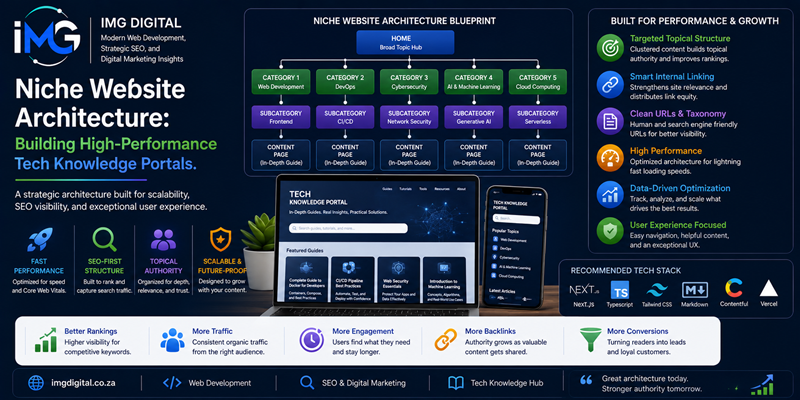
Niche Website Architecture: Building High-Performance Tech Knowledge Portals – Digital information platforms have evolved far beyond standard blogging formats. In the past, publishing platforms relied on simple chronological feeds to display technical documentation and industry guides. However, modern technology professionals demand immediate, well-organized access to complex documentation.
Niche Website Architecture: Building High-Performance Tech Knowledge Portals
As a result, building specialized tech knowledge portals requires a dedicated approach to information design. Specifically, establishing a robust niche website architecture ensures that complex technical data remains fast, scannable, and easily indexable by modern search engines. Therefore, this comprehensive guide explores how engineering teams can construct high-performance knowledge hubs designed for long-term scalability.
Information Architecture: Structuring Data for Maximum Scannability
Designing a technical knowledge portal requires organizing vast amounts of information into intuitive navigation paths. If content is scattered haphazardly across flat site directories, users struggle to find specific solutions quickly.
Topic Clustering and the Hub-and-Spoke Model
To establish clear topical authority, developers must implement a structured hub-and-spoke model. Specifically, central pillar pages serve as primary content hubs for broad technical subjects, such as cloud computing or database optimization. In addition, granular sub-topic guides branch out from these central hubs. By linking supporting articles back to parent pillar pages, search engine crawlers parse topical relationships effortlessly. Consequently, domain authority increases while user navigation experience improves.
Logical URL Hierarchy and Breadcrumbs
Furthermore, clean URL structures provide explicit structural context to both users and search bots. Instead of using arbitrary post IDs or date-based URLs QQ Game, niche platforms should enforce clean hierarchical paths:
/* Recommended Knowledge Portal Path */
https://domain.co.za/tech/javascript/architecture-guide
As shown above, explicit URL structures reflect true content organization. In addition, integrating dynamic breadcrumbs allows visitors to navigate upward through category layers seamlessly. As a result, user bounce rates decrease significantly across complex knowledge bases.
Engineering High-Performance Rendering Architectures
Speed remains a critical foundation for technical knowledge portals. Because software engineers and developers visit knowledge hubs while actively coding, latency directly impairs productivity.
Modern Rendering Frameworks
Historically, dynamic content management systems rendered every page request on-demand using server-side processing. However, this approach introduces execution latency and server bottlenecks during high traffic spikes. To solve this problem, modern niche website architecture leverages Static Site Generation (SSG) or incremental static regeneration. By pre-rendering technical articles into static HTML during build cycles, pages load almost instantaneously across global edge networks. Consequently, Time to First Byte (TTFB) drops dramatically.
Optimizing On-Site Search Capabilities
While standard navigation menus help users explore categories, technical portals rely heavily on internal search engines. If internal search queries execute slowly, user satisfaction declines rapidly. Therefore, developers should integrate client-side instant search libraries or headless search indexers. As a result, visitors filter code snippets, API reference guides, and troubleshooting documentation within milliseconds.
Content Usability and Code Block Optimization
Presenting technical documentation effectively requires specialized user interface formatting. Because technical readers scan code examples and parameter tables rapidly, content design must prioritize visual clarity.
-
Interactive Syntax Highlighting: By utilizing lightweight syntax highlighting libraries, platforms render code blocks with distinct color coding. In addition, adding one-click copy buttons allows developers to copy code snippets without manual text selection errors.
-
Automated Table of Contents: In addition, long-form technical guides must feature sticky, automated table-of-contents widgets. Consequently, readers jump directly to relevant sections without scrolling through lengthy documentation manually.
-
Structured Technical Tables: Furthermore, comparing complex software frameworks or API endpoints requires clean data tables. When data is presented in structured tables, search engines parse entity attributes more effectively.
Strategic Link Integrity and System Maintenance
Sustaining a high-performance knowledge portal requires continuous technical hygiene. Over time, external documentation references change, APIs evolve, and legacy links break.
-
Automate Broken Link Detection: Broken external references damage trust and waste search crawl budgets. Therefore, automated auditing scripts should continuously verify outbound documentation links. As a result, dead links are resolved before affecting user experience.
-
Enforce Entity-Based Schema Markup: Specifically, technical portals should deploy
TechArticle,APIReference, andHowToschema tags. Consequently, search engines identify specialized code blocks and step-by-step solutions directly for rich search results. -
Maintain Modular Component Codebases: Keeping frontend components modular ensures that updating site navigation or code blocks does not introduce technical regression. Therefore, development teams maintain agility as the platform expands.
Summary
In conclusion, building high-performance tech knowledge portals requires aligning clean information architecture with modern web engineering practices. By adopting structured topic clusters, fast static rendering architectures, optimized code presentation, and comprehensive schema markup, engineering teams deliver superior digital platforms. Furthermore, prioritizing speed and scannability satisfies modern search engine performance guidelines. Ultimately, executing a strategic niche website architecture ensures your technical portal establishes lasting domain authority, empowers developers, and scales effortlessly over time.