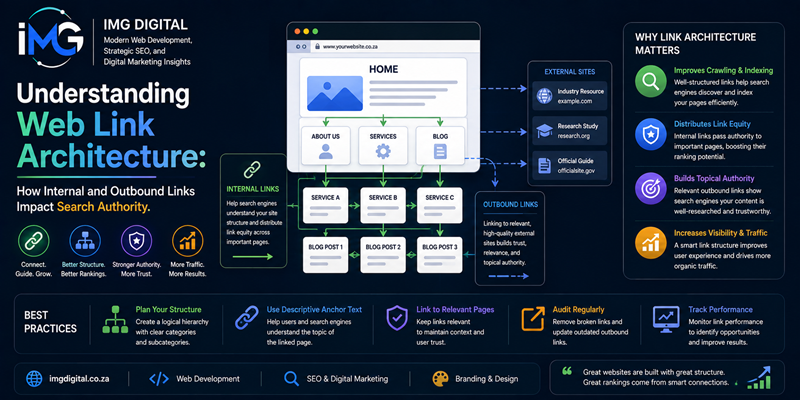
Understanding Web Link Architecture: How Internal and Outbound Links Impact Search Authority – Search engine optimization relies heavily on how information travels across digital networks. In the past, webmasters viewed hyperlinks merely as functional paths for user navigation. However, modern search algorithms evaluate hyperlinks as structural pathways that distribute authority and topical context.
Understanding Web Link Architecture: How Internal and Outbound Links Impact Search Authority
Specifically, web link architecture defines how internal and outbound links pass equity across your domain. As a result, executing a structured link strategy directly impacts how search crawlers index your content. Therefore, understanding the mechanics of web link architecture is essential for maximizing domain authority.
The Mechanics of Internal Link Architecture
Internal links represent hyperlinks that connect distinct pages within the exact same domain. To understand their importance, web developers must evaluate how search crawlers calculate link equity. When search engine bots crawl a web page, they assign numeric authority values based on incoming links. Consequently, internal links act as conduits that distribute this search authority across your website.
Furthermore, internal linking establishes clear topical hierarchies. By connecting related articles together, you create logical content clusters that search engines parse easily. For example, linking a high-level guide to specialized sub-topic pages signals strong domain expertise. As a result, search engines recognize your platform as a comprehensive topical authority, elevating overall organic rankings.
Strategic Internal Linking Models for Optimal Authority Flow
Engineering a scalable link structure requires adopting proven architectural models. Below, key structural frameworks illustrate how to organize internal connections effectively.
1. The Pyramid Silo Architecture
In a traditional pyramid structure, the homepage resides at the apex, passing authority down to main category pages. Subsequently, category pages distribute equity to individual sub-topic articles. Because authority flows logically downward and laterally, every page receives balanced crawl priority.
2. Contextual Anchor Text Optimization
While internal pathways guide search crawlers, anchor text provides explicit semantic context. Specifically, developers should use descriptive, keyword-rich anchor text rather than generic phrases like “click here.” However, anchor text must remain natural and varied. If an application over-optimizes exact-match anchor text, search algorithms may flag the pattern as manipulative. Consequently, using descriptive entity-based anchor text ensures safe, effective context delivery.
3. Eliminating Orphan Pages
In addition, web administrators must prevent orphan pages. Specifically, an orphan page lacks any incoming internal links from other domain pages. Because search crawlers discover pages primarily through links, orphan pages remain difficult to index. Therefore, integrating every new page into existing topic clusters guarantees consistent crawl efficiency.
The Strategic Role of Outbound Links in Establishing Trust
While internal links manage local authority distribution, outbound links connect your domain to the broader global web. Historically, some developers feared that linking out to external websites would drain their own page authority. However, modern search algorithms encourage linking to high-quality external sources.
1. Citing Authoritative External Entities
When an article cites reputable research, government studies, or established industry references, search engines view the content as trustworthy. Specifically, outbound links help algorithms verify facts and map entity relationships across the Knowledge Graph. Consequently, citing high-authority sources enhances overall content credibility.
2. Managing Link Attributes (nofollow vs. dofollow)
To protect search authority, technical teams must apply appropriate link attributes:
-
dofollow(Standard): Passes authority naturally to trusted editorial sources. -
rel="nofollow": Instructs crawlers not to endorse untrusted external links or paid resources. -
rel="sponsored": Explicitly identifies commercial links, affiliate offers, and paid advertisements.
By utilizing appropriate link attributes, developers maintain complete control over outbound equity transfer. Therefore, external connections reinforce platform authority without risking algorithmic penalties.
Technical Link Auditing Best Practices
Maintaining an efficient web link architecture requires continuous technical maintenance. Over time, websites modify URLs, remove legacy content, or update directory structures. Consequently, unmonitored LINK QQ ALTERNATIF structures degrade search performance.
-
Resolve Broken Links (404 Errors): Broken internal links waste search engine crawl budgets and frustrate users. Therefore, regular automated audits keep link paths clean.
-
Minimize Redirect Chains: When internal links point to 301 redirects, latency increases and link equity dissipates. As a result, developers should update internal links to target final destination URLs directly.
-
Balance Link Density: Placing excessive links on a single page dilutes the authority passed by each individual link. Consequently, web pages should maintain balanced, contextually relevant link counts.
Summary
In conclusion, mastering web link architecture is a vital requirement for technical SEO success. By structuring clean internal link hierarchies, optimizing contextual anchor text, and referencing authoritative external sources, digital platforms maximize search authority. Furthermore, resolving technical link errors prevents crawl budget waste and optimizes user experience. Ultimately, executing a strategic link architecture ensures your web application builds sustained organic visibility and long-term domain trust across search engines.