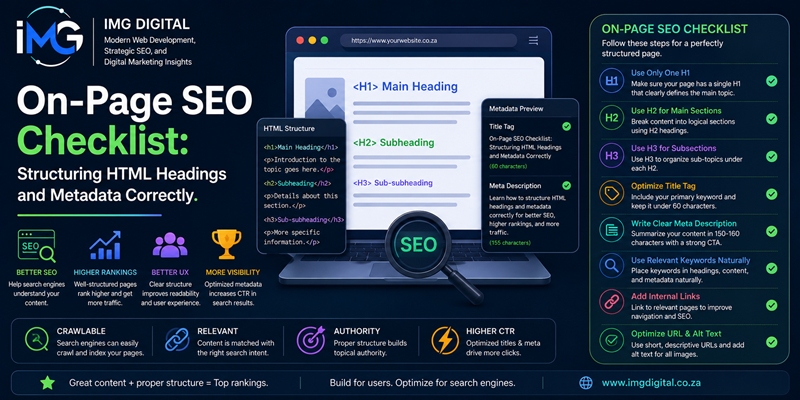
On-Page SEO Checklist: Structuring HTML Headings and Metadata Correctly – Search engine optimization relies heavily on clear communication between web pages and search crawlers. In the past, basic keyword repetition across page copy was sufficient to achieve high search rankings. However, modern search algorithms prioritize semantic clarity, document architecture, and user experience.
On-Page SEO Checklist: Structuring HTML Headings and Metadata Correctly
Specifically, how developers and content creators structure HTML headings and metadata directly impacts indexation and click-through rates. Consequently, executing a structured on-page technical checklist is essential for organic search success. Therefore, this comprehensive guide details how to structure HTML headings and metadata correctly.
Crafting High-Impact Title Tags and Meta Descriptions
Metadata serves as the primary preview snippet displayed across search engine result pages (SERPs). Therefore, optimizing these HTML elements represents the first step in driving organic traffic.
-
Title Tags (
<title>): The title tag remains one of the strongest on-page ranking signals. Specifically, it should concisely convey the main page topic while incorporating the primary focus keyphrase near the beginning. In addition, keeping title lengths between 50 and 60 characters prevents awkward text truncation in search results. As a result, users see clear, compelling titles. -
Meta Descriptions: Although meta descriptions do not act as direct ranking factors, they strongly influence user click-through rates (CTR). When meta descriptions clearly summarize page content and include a strong call-to-action within 150 to 160 characters, searchers feel encouraged to click. Furthermore, search engines highlight matching search terms within the description, increasing visual prominence.
Establishing a Logical HTML Heading Hierarchy
Proper HTML heading structures create a readable roadmap for both human visitors and search engine crawlers. When headings are implemented logically, search engines easily interpret topical relationships across your content. Core Web Vitals Guide: Technical SEO Best Practices for Fast Loading Speeds
1. The Single <h1> Rule
Every web page must contain exactly one <h1> heading. Specifically, this primary heading represents the main topic of the page and should closely align with the meta title tag. If a page uses multiple <h1> tags indiscriminately, search crawlers struggle to identify the core subject matter. Consequently, topical relevance becomes diluted.
2. Sequential Subheadings (<h2> to <h6>)
Subheadings categorize supporting ideas logically throughout an article. For instance, <h2> tags denote major sub-topics, while <h3> through <h6> tags divide deeper sub-sections. Furthermore, developers must avoid skipping heading levels, such as jumping directly from an <h2> to an <h4>. Because screen readers and search crawlers rely on sequential order, maintaining structural hierarchy improves accessibility and SEO readability simultaneously.
Integrating Social Graph Tags and Technical Metadata
Beyond basic titles and headings, advanced metadata ensures consistent page representation across different digital platforms.
Open Graph and Twitter Card Metadata
When users share your web links across social networks, Open Graph (og:title, og:image, og:description) and Twitter Card tags control how preview cards appear. Consequently, custom social metadata prevents platforms from pulling arbitrary images or unstructured text snippets. As a result, social engagement and referral traffic increase significantly.
Canonical Tags and Meta Robots Directives
Technical metadata controls how crawlers index specific web pages. Specifically, the <link rel="canonical"> tag specifies the primary version of a URL, preventing duplicate content penalties across e-commerce or syndicated platforms. In addition, using meta robots tags like <meta name="robots" content="index, follow"> provides explicit instructions regarding indexing boundaries.
The Complete On-Page SEO Checklist
To ensure your web pages fulfill technical search standards, review this streamlined implementation checklist before publishing content:
| Element | Best Practice Rule | Primary Objective |
| Title Tag | 50–60 characters; primary keyword near start | SERP visibility & direct ranking signal |
| Meta Description | 150–160 characters; actionable call-to-action | Click-through rate (CTR) optimization |
<h1> Tag |
Exactly one per page; aligns with main topic | Core document identification |
| Heading Hierarchy | Sequential <h2>–<h6> structure; no skipped levels |
Topical clarity & accessibility |
| Canonical URL | Explicit self-referencing or master URL link | Preventing duplicate content issues |
| Image Alt Text | Descriptive, entity-rich image explanations | Web accessibility & Image SEO |
Summary
In conclusion, mastering on-page SEO requires rigorous attention to structural markup and technical metadata. By structuring logical heading hierarchies, crafting persuasive metadata snippets, and implementing canonical directives, web developers maximize search performance. Furthermore, clean HTML architecture improves usability for human readers and assistive technologies alike. Ultimately, executing this on-page checklist ensures your web platform achieves sustained organic visibility across modern search engines.