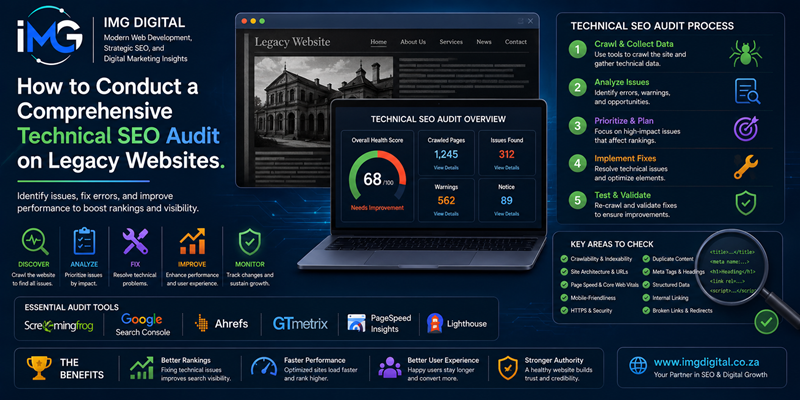
How to Conduct a Comprehensive Technical SEO Audit on Legacy Websites – Modern digital enterprises frequently rely on legacy websites that have operated for years. However, over continuous cycles of maintenance, content updates, and platform migrations, these websites inevitably accumulate significant technical debt.
How to Conduct a Comprehensive Technical SEO Audit on Legacy Websites
As a result, outdated codebases, broken internal links, redundant redirect chains, and indexing errors quietly degrade overall search performance. Specifically, search crawlers encounter severe efficiency bottlenecks when navigating unmaintained site architectures.
Therefore, conducting a systematic technical SEO audit on legacy websites is essential to restore domain authority, optimize crawl budgets, and improve organic visibility.
Phase 1: Diagnosing Crawlability and Indexation Health
The initial stage of auditing a legacy platform involves evaluating how search engine bots crawl and index site pages. Because legacy domains frequently contain thousands of historical URLs, unguided crawlers waste valuable resources on non-essential pages.
1. Analyzing Crawl Log Files and Search Console Reports
To begin, audit teams should analyze server log files alongside Google Search Console coverage reports. Specifically, log file analysis reveals exactly how often search crawlers visit specific directories. If crawlers spend excessive time fetching low-value parameter URLs or deprecated staging folders, primary content suffers from delayed indexation. Consequently, updating your robots.txt file to block unnecessary directories preserves crawl efficiency.
2. Evaluating XML Sitemaps and Canonical Directives
Furthermore, legacy websites often maintain outdated XML sitemaps containing redirected or dead URLs. To resolve this issue, ensure your sitemap includes only canonical, indexable 200 OK status URLs. In addition, verify that every published page features a clean, self-referencing canonical tag. As a result, search engines parse primary content without encountering duplicate indexation signals.
Phase 2: Resolving Legacy Redirect Chains and URL Debts
Multiple website redesigns and domain migrations frequently leave behind complex redirection structures across legacy systems. When search bots follow multiple redirect hops, crawl budget is rapidly depleted and link equity dissipates.
/* Problematic Legacy Chain */
http://example.co.za/old-page -> https://example.co.za/old-page -> https://example.co.za/new-page

/* Optimized Direct Link */
http://example.co.za/old-page -> https://example.co.za/new-page
As illustrated above, replacing multi-step redirect chains with direct 301 redirects restores lost link equity instantly. Furthermore, technical teams must identify and eliminate redirect loops, which cause crawlers to abandon URL discovery completely. Consequently, simplifying redirect mapping accelerates server response times and stabilizes page authority distribution.
Phase 3: Code Modernization and Core Web Vitals Optimization
Legacy codebases frequently rely on obsolete frontend libraries, heavy inline styles, and uncompressed media assets. Consequently, page loading speeds suffer, triggering poor Core Web Vitals performance. Schema Markup & Structured Data: A Step-by-Step Guide for Web Developers
1. Streamlining Render-Blocking Resources
In many cases, legacy websites load multiple synchronous JavaScript files and legacy CSS frameworks in the document head. Because these scripts block browser rendering, metrics like Largest Contentful Paint (LCP) degrade significantly. Therefore, developers should defer non-essential scripts, inline critical CSS, and eliminate unused code dependencies.
2. Eliminating DOM Bloat and Mobile Usability Errors
In addition, outdated CMS templates often generate excessively deep DOM trees containing thousands of nested HTML tags. When DOM complexity becomes overwhelming, mobile devices struggle to compute page layouts efficiently. To solve this problem, refactoring legacy layout templates into lightweight, semantic HTML structures improves Interaction to Next Paint (INP) scores substantially.
Phase 4: Auditing Internal Link Architecture and Schema Markup
Maintaining a healthy internal link structure becomes increasingly complex as legacy websites expand over time. Consequently, structural decay often isolates valuable content behind broken pathways.
-
Eliminating Orphan Pages: During routine content updates, legacy pages frequently lose internal incoming links. Because search bots rely on internal pathways to assign authority, reconnecting orphan pages into active topic clusters restores their indexability.
-
Updating Obsolete Schema Markup: In addition, legacy websites often contain deprecated microdata or broken JSON-LD scripts. By updating schema markup to conform with modern Schema.org specifications, developers ensure search engines interpret business entities correctly. As a result, the website regains eligibility for rich search results.
In conclusion, auditing a legacy website requires a disciplined, multi-layered technical approach. By systematically diagnosing crawl issues, eliminating redirect chains, modernizing legacy codebases, and updating internal link structures, technical teams eliminate years of accumulated technical debt. Furthermore, resolving these underlying infrastructure bottlenecks improves both human user experience and search engine accessibility. Ultimately, conducting regular technical SEO audits ensures legacy digital platforms remain performant, competitive, and fully optimized across modern search engine landscapes.