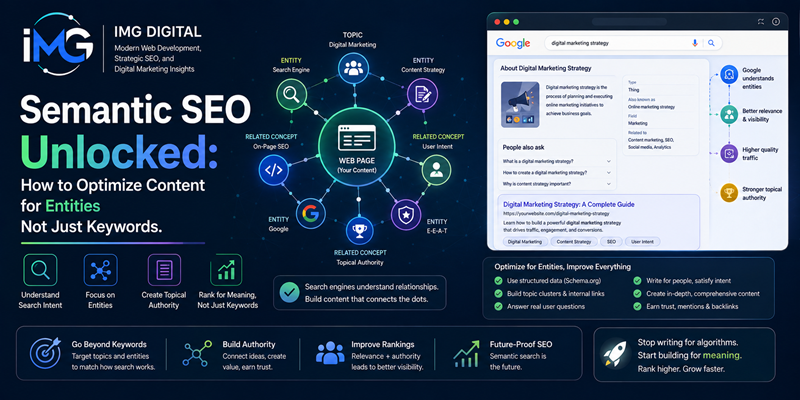
Semantic SEO Unlocked: How to Optimize Content for Entities, Not Just Keywords – Search engine optimization has experienced a massive evolution over the past decade. In the past, search algorithms relied almost exclusively on exact-match keywords and backlink counts to rank web pages. However, modern search engines powered by machine learning now process language much like humans do.
Semantic SEO Unlocked: How to Optimize Content for Entities, Not Just Keywords
As a result, search algorithms no longer evaluate pages as isolated strings of text. Instead, they analyze web content through the lens of semantic context and interconnected concepts. Therefore, unlocking Semantic SEO requires shifting your content strategy from keyword density toward entity-based optimization.
Understanding Entities versus Traditional Keywords
To master semantic optimization, understanding the fundamental distinction between keywords and entities is essential. Historically, keywords represented simple text strings that content creators repeated across articles. Consequently, websites often achieved high search rankings through artificial keyword stuffing rather than delivering genuine value.
Conversely, an entity is defined by search engines as a singular, well-defined concept or object that is unique, distinguishable, and unambiguously named. For example, entities include physical objects, specific people, geographical locations, organizations, and abstract ideas. Unlike plain keywords, entities exist within global knowledge networks known as Knowledge Graphs. In these networks, search engines connect entities together through explicit relationships. For instance, instead of seeing “SEO agency in Cape Town” as five separate words, Google recognizes “SEO” as a service, “Cape Town” as a city, and “Agency” as a business type. Consequently, semantic search engines understand the deeper intent behind search queries.
Core Strategies for Entity-Based Content Optimization
Transitioning toward entity-centric content creation requires a structured approach to topical authority. Below, three essential techniques demonstrate how to optimize web pages for semantic search engines.
1. Build Comprehensive Topic Clusters
Rather than creating standalone articles targeting isolated keywords, content strategists should develop interconnected topic clusters. Specifically, a topic cluster consists of a broad pillar page supported by multiple detailed sub-topic articles. By linking these sub-topics back to the central pillar page, you demonstrate comprehensive coverage of an entire subject domain. As a result, search engines recognize your website as a trusted topical authority.
2. Implement Schema Markup and Structured Data
While natural language processing helps search engines interpret text, structured data provides explicit, machine-readable context. By implementing Schema.org markup in JSON-LD format, developers can define page entities directly in code. For example, adding Organization, Article, or Service schema tags explicitly informs search crawlers about your content’s subject matter. Consequently, your website becomes eligible for rich search results and enhanced Knowledge Graph placements.
3. Incorporate Related Entities and Natural Language
When writing about a primary subject, natural language naturally introduces related concepts, co-occurring terms, and secondary entities. For instance, an article discussing modern web development should naturally reference HTML5, CSS3, JavaScript, web accessibility, and performance optimization. If an article lacks these expected related entities, search engines may perceive the content as superficial or incomplete. Therefore, writers should cover subjects holistically rather than forcing repetitive keyword phrases into sentences. Web Accessibility (a11y) Guide: Making Modern Web Apps Inclusive for Everyone
Aligning Semantic SEO with AI and Generative Search
As search engines evolve into conversational AI platforms, semantic understanding becomes even more critical. In fact, modern systems like Google AI Overviews and answer engines rely heavily on entity relationships to synthesize answers. When your content clearly establishes connections between relevant industry entities, AI models can summarize and attribute your content as a primary answer source. Thus, entity-based optimization directly prepares your digital platform for the future of Generative Engine Optimization (GEO).
Summary
In conclusion, Semantic SEO represents a paradigm shift from keyword matching to concept understanding. By focusing on entity relationships, implementing structured schema markup, and building authoritative topic clusters, content creators satisfy modern search engine expectations. Furthermore, entity-based content delivers richer, more comprehensive value to human readers. Ultimately, unlocking Semantic SEO ensures your web platform builds long-term search visibility, domain authority, and digital relevance in an AI-driven web ecosystem.