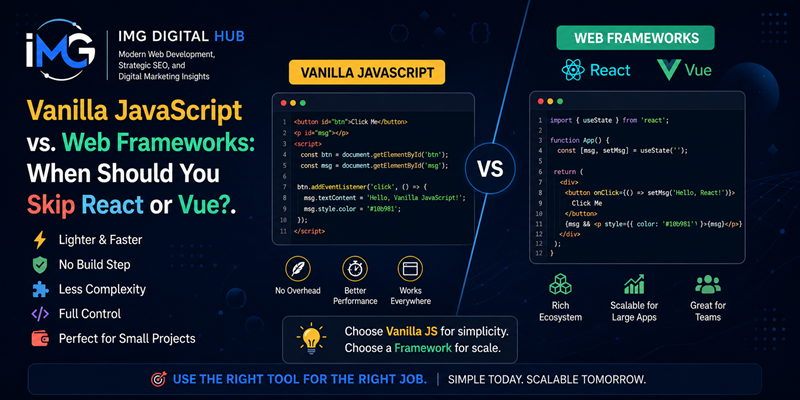
Vanilla JavaScript vs. Web Frameworks: When Should You Skip React or Vue? Modern web development is deeply intertwined with component-based JavaScript frameworks. Over the past decade, libraries like React and frameworks such as Vue.js have become default choices for front-end engineering teams worldwide. They offer declarative rendering, reusable UI components, and rich ecosystem tooling. Consequently, many developers routinely install complex npm packages before evaluating whether a project actually requires them.
Vanilla JavaScript vs. Web Frameworks: When Should You Skip React or Vue?
However, modern web standards have advanced significantly over recent years. Today, plain, unadulterated “Vanilla JavaScript” provides remarkable capabilities without requiring external dependencies or build tools. Front-end architects increasingly ask a crucial question: when is it better to skip React or Vue in favor of native browser APIs?
The Hidden Costs of Framework Overhead
While frameworks accelerate initial development speed for complex user interfaces, they introduce non-trivial performance overhead. Every framework requires sending runtime library code over the network to the end user’s browser. Even with advanced code-splitting and tree-shaking techniques, popular libraries add tens to hundreds of kilobytes to JavaScript bundle sizes.
Furthermore, client-side rendering frameworks rely on abstraction layers, such as the Virtual DOM, to reconcile state changes. While this abstraction simplifies complex state management, it introduces execution delays on lower-end mobile devices. Parsing, compiling, and executing heavy JavaScript bundles directly impacts critical Core Web Vitals metrics, including Interaction to Next Paint (INP) and Total Blocking Time (TBT). When websites require ultra-fast initial loading speeds, heavy framework bundles can hinder user experience and search engine rankings.
The Evolving Power of Native JavaScript
Developers often forget that JavaScript frameworks were originally created to solve limitations in older browser implementations. Modern ECMAScript standards have eliminated many of those historic pain points. Today, native browser APIs offer powerful features that previously required third-party libraries:
-
DOM Manipulation: Methods like
querySelector,closest, andclassListmake DOM traversals intuitive, highly performant, and clean. -
Asynchronous Operations: The native
fetchAPI paired withasync/awaitsyntax simplifies HTTP requests without requiring third-party libraries like Axios. -
Native Web Components: Custom Elements and Shadow DOM allow developers to build encapsulated, reusable UI components natively across all modern browsers.
-
Built-in Animations: CSS Custom Properties combined with the Web Animations API deliver smooth, hardware-accelerated animations directly in the browser environment.
As a result, building interactive UI components with pure JavaScript is simpler and cleaner than ever before.
Key Scenarios Where You Should Skip React or Vue
Deciding between Vanilla JavaScript and a framework should depend on project scope, architectural requirements, and performance goals. Here are common scenarios where skipping React or Vue is the wiser architectural decision:
1. Content-Focused Websites and Portals
Blogs, news publications, and marketing sites primarily display text and media. Adding React or Vue to manage minor interactive elements, such as mobile navigation toggles or modal dialogs, creates unnecessary performance bottlenecks. Master Modern Layouts: CSS Grid vs. Flexbox with Practical Code Examples
2. Performance-Critical Landing Pages
Pages designed specifically for high-conversion marketing campaigns or mobile ad traffic require near-instantaneous load times. Pure HTML, CSS, and Vanilla JavaScript guarantee minimal file sizes and immediate interactivity.
3. Embedded Widgets and Micro-Apps
When building shareable widgets, calculators, or third-party scripts intended for integration into external websites, using Vanilla JavaScript avoids version conflicts and reduces footprint.
4. Long-Term Enterprise Projects
Third-party frameworks evolve rapidly, frequently introducing breaking changes and deprecations. Native JavaScript code written today will remain functional across web browsers for decades without continuous dependency updates.
When Web Frameworks Remain the Better Choice
Choosing Vanilla JavaScript does not imply that modern frameworks are obsolete. React, Vue, and Angular remain highly beneficial for specific application architectures and team workflows.
When building data-dense Single Page Applications (SPAs), SaaS dashboards, or platforms requiring complex, synchronized state management across dozens of UI components, frameworks provide essential structure. They enforce consistent architectural patterns across large engineering teams, streamline state synchronization, accelerate developer onboarding, and offer rich ecosystem tools. The objective is not to abandon frameworks completely, but rather to deploy them pragmatically when application complexity truly warrants their inclusion.
Summary
Modern web development requires choosing the appropriate tool for each specific project constraint. While React and Vue excel at managing complex single-page application states, Vanilla JavaScript delivers superior performance, minimal long-term maintenance, and zero bundle overhead for simpler, content-driven websites. By evaluating project requirements before installing third-party dependencies, front-end developers can build faster, cleaner, and more resilient web applications.