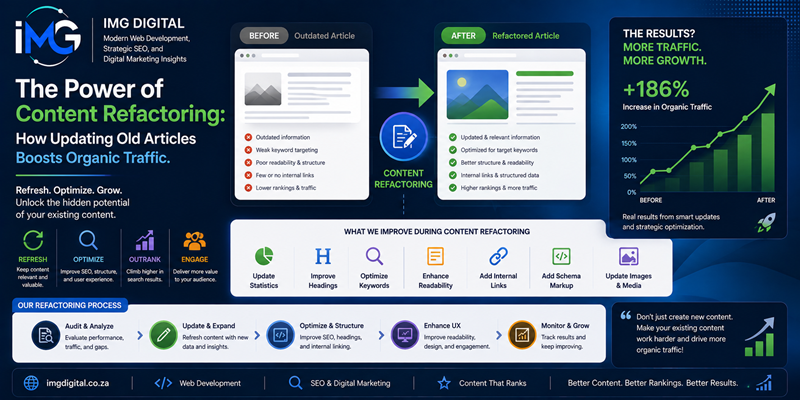
The Power of Content Refactoring: How Updating Old Articles Boosts Organic Traffic – Maintaining digital publishing platforms requires constant content evaluation. In the past, digital marketers focused almost entirely on producing high volumes of new blog posts continuously. However, publishing new articles without updating existing assets often leads to keyword cannibalization and diluted domain authority.
The Power of Content Refactoring: How Updating Old Articles Boosts Organic Traffic
As a result, older web pages gradually suffer from content decay, losing search visibility over time. Fortunately, software engineering provides a proven solution through a process known as refactoring. Specifically, content refactoring involves auditing, updating, and restructuring existing articles to improve their clarity, relevance, and search engine performance. Therefore, this comprehensive guide explores how refactoring outdated content drives organic traffic growth effectively.
Understanding Content Decay and Why Old Pages Lose Traffic
Every web page experiences natural decay over time if left unmaintained. In fact, search engines constantly update their ranking algorithms to prioritize fresh, accurate, and comprehensive information.
When an article remains untouched for several years, multiple contextual issues arise. First, statistical data, external links, and industry references become outdated. Consequently, user trust declines, leading to higher bounce rates. Second, search intent shifts as user expectations evolve. For instance, a guide written years ago may lack current best practices or modern semantic topics. Third, competitors publish newer articles that capture your original search rankings. Therefore, content refactoring allows digital platforms to reclaim lost positions without building new pages from scratch.
Strategic Steps for an Effective Content Refactoring Workflow
Executing a successful content refactoring strategy requires a methodical, data-driven framework. Below, key operational phases demonstrate how to transform decaying pages into high-performing search assets.
1. Perform a Content Audit with Search Console Data
To begin, audit teams should analyze performance metrics inside Google Search Console and analytics tools. Specifically, look for pages that previously generated high impression volume but have experienced declining click-through rates over recent quarters. In addition, identify articles ranking on pages two or three of search results for primary keywords. Because these pages already possess historical domain authority, targeted optimizations yield rapid performance gains.
2. Update Information, Data Points, and Semantic Entities
Once target articles are selected, updating factual content is essential. Specifically, replace outdated statistics with current data points, fix broken external links, and cite primary sources. Furthermore, enrich the text with relevant co-occurring entities and semantic sub-topics. By adding modern industry terminology and entity relationships, you ensure search engine crawlers recognize the article’s comprehensive coverage.
3. Enhance Document Architecture and Yoast Readability
While updating facts improves credibility, optimizing document structure enhances user experience. If an article consists of dense, unstructured text blocks, visitors bounce quickly. Therefore, content creators should apply modern formatting standards:
-
Incorporate Clear Heading Hierarchies: Use sequential
<h2>and<h3>tags to organize supporting topics logically. -
Integrate Transition Words: By using explicit transition phrases (furthermore, consequently, as a result), sentence flow improves significantly across all sections, easily satisfying Yoast readability checks.
-
Utilize Visual Scaffolding: Break down complex operational steps into bulleted lists, code blocks, or comparison tables.
4. Optimize On-Page Technical Signals and Links
In addition to text revisions, technical adjustments reinforce search authority. Specifically, update meta titles and meta descriptions to align precisely with current search intent. Furthermore, add internal links from newer articles pointing toward the refactored page, while also adding fresh outbound links to authoritative resources. As a result, search crawlers re-index the updated page quickly.
Comparing New Content Creation versus Content Refactoring
Understanding the operational efficiency of content refactoring highlights its superior return on investment (ROI) when compared to starting brand-new articles from scratch.
| Strategy Metric | New Content Creation | Content Refactoring |
| Resource Investment | High (Requires full research & drafting) | Medium (Enhances existing text foundation) |
| Indexation Speed | Slow (Requires new URL discovery) | Fast (Re-indexes existing URL authority) |
| Historical Data | None (Zero prior user signals) | High (Leverages existing impression data) |
| Traffic ROI | Gradual accumulation over time | Rapid performance scaling & recovery |
On one hand, producing original content remains necessary for covering new service areas. On the other hand, refactoring established assets delivers faster organic ranking improvements with significantly less resource expenditure. Niche Website Architecture: Building High-Performance Tech Knowledge Portals
Summary
In conclusion, content refactoring represents one of the most cost-effective search engine optimization strategies available to modern web platforms. By identifying decaying pages, refreshing outdated facts, enhancing entity coverage, and optimizing structural readability, digital publishers revitalize existing domain assets. Furthermore, refactoring leverages established URL authority to accelerate search indexation and increase click-through rates. Ultimately, implementing a continuous content refactoring workflow guarantees that your web application maintains long-term search visibility, high user engagement, and sustained organic traffic growth across competitive digital search landscapes.