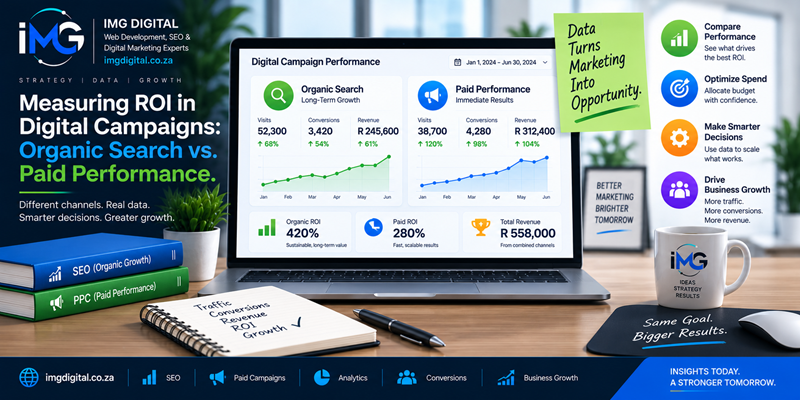
Measuring ROI in Digital Campaigns: Organic Search vs. Paid Performance – Allocating capital across modern marketing channels requires rigorous financial evaluation and strategic discipline. In the past, business leaders viewed digital advertising spend as a secondary operational expense rather than a core revenue driver. However, today’s competitive landscape demands precise measurement of Return on Investment (ROI) across all digital acquisition efforts.
Measuring ROI in Digital Campaigns: Organic Search vs. Paid Performance
Specifically, marketing executives must evaluate two primary performance channels: Organic Search (SEO) and Paid Performance (PPC). While both strategies aim to capture user demand and generate revenue, their underlying cost models and financial mechanics differ substantially. Consequently, understanding how to measure ROI across organic and paid channels is essential for optimizing digital marketing budgets effectively. Therefore, this comprehensive guide explores the analytical frameworks required to evaluate both acquisition channels accurately.
The Financial Mechanics of Organic Search ROI
Measuring organic search ROI requires evaluating long-term compounding returns against upfront operational investments. Unlike paid performance channels, organic search does not charge a direct fee for every visitor click. However, achieving high organic search visibility demands significant capital expenditure in technical infrastructure, content strategy, and domain authority building.
To calculate true organic search ROI, organizations must aggregate total technical development costs, content creation expenses, and ongoing optimization fees over a specific timeframe. Then, this cumulative investment is measured directly against revenue generated from organic search conversions. Because organic assets continue to attract traffic long after their initial publication, customer acquisition costs (CAC) decay significantly over time. Consequently, organic search delivers compounding equity that increases overall domain authority. Furthermore, high organic rankings reinforce brand credibility, resulting in elevated baseline conversion rates across the entire marketing funnel.
Evaluating Immediate Returns in Paid Performance
Paid performance marketing offers immediate scalability, precise targeting, and direct financial predictability. By bidding on search keywords, social media placements, or display ad networks, organizations purchase instant visibility across targeted user segments. The Intersection of UX Design and Digital Marketing: Maximizing Site Conversions
Specifically, calculating paid performance ROI relies heavily on direct short-term performance metrics such as Cost Per Click (CPC), Cost Per Acquisition (CPA), and Return on Ad Spend (ROAS). When an organization launches a paid ad campaign, advertising platforms track revenue attribution directly against ad spend in real time. Consequently, growth teams can determine immediate campaign profitability effortlessly. However, paid performance operates on a strictly linear cost structure. When ad spend stops, traffic generation ceases instantly. In addition, ad fatigue and rising bidding competition often increase acquisition costs over time. Therefore, paid performance requires continuous budget allocation to maintain sales velocity and market presence.
Comparative Analysis: Organic Search versus Paid Performance
Comparing the financial dynamics of organic search and paid performance highlights how each channel influences long-term profitability differently.
| Metric Dimension | Organic Search (SEO) | Paid Performance (PPC) |
| Time to Impact | Medium to Long-Term (3–6 Months) | Immediate (Real-Time Results) |
| Cost Structure | Upfront Investment; Zero Cost Per Click | Pay-Per-Click / Pay-Per-Impression |
| Scalability | Compounding Equity over Time | Linear Scaling bounded by Ad Budget |
| Traffic Retention | Persistent Traffic after Creation | Immediate Drop-off when Spend Stops |
| Primary Metric | Organic Conversion Value & LTV | ROAS, CPA, and Immediate Revenue |
On one hand, paid performance provides rapid testing environments and immediate revenue generation for new product launches. On the other hand, organic search establishes sustainable digital assets that lower long-term acquisition costs. Consequently, balancing both channels ensures optimal short-term performance and long-term equity growth.
Blending Channels for Maximum Total Marketing ROI
Rather than treating organic search and paid performance as competing channels, growth-focused organizations integrate both strategies into a unified performance ecosystem.
1. Cross-Channel Keyword Intelligence
By analyzing high-converting paid search queries, SEO teams isolate lucrative target keywords for organic content creation. Conversely, organic search performance identifies high-intent queries that warrant immediate paid ad coverage to capture dominant SERP real estate. As a result, marketing teams eliminate keyword guesswork and optimize acquisition efficiency across both channels simultaneously.
2. Multi-Touch Attribution in GA4
Furthermore, modern customer journeys frequently touch both organic and paid touchpoints prior to completing a conversion. Using data-driven attribution models in Google Analytics 4, organizations evaluate how top-of-funnel paid ads interact with organic search touchpoints. Consequently, marketers allocate budget dynamically across channels based on empirical contribution data rather than subjective assumptions.
Summary
In conclusion, measuring ROI across digital campaigns requires a balanced evaluation of immediate returns and long-term compounding value. By leveraging paid performance for immediate market validation and organic search for sustainable asset building, organizations construct resilient acquisition frameworks. Furthermore, utilizing multi-touch attribution models ensures every marketing dollar contributes directly to business growth. Ultimately, mastering cross-channel ROI measurement empowers digital enterprises to optimize budget allocation, lower customer acquisition costs, and achieve sustainable competitive leadership across digital search landscapes.