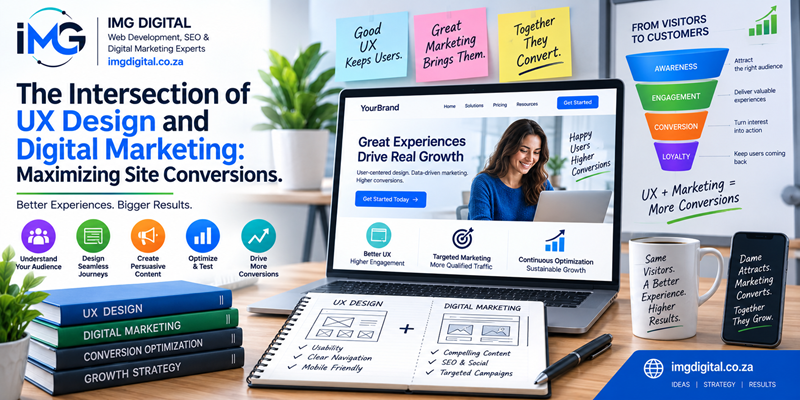
The Intersection of UX Design and Digital Marketing: Maximizing Site Conversions – Digital acquisition strategies rely heavily on driving targeted web traffic through paid advertising, search engine optimization, and content distribution. In the past, organizations treated digital marketing and User Experience (UX) design as separate operational disciplines. Specifically, marketing teams focused exclusively on acquiring visitors, while design teams managed interface layouts independently.
The Intersection of UX Design and Digital Marketing: Maximizing Site Conversions
However, driving high visitor volumes without providing an intuitive, frictionless user experience leads to high bounce rates and wasted ad budgets. Consequently, modern digital growth strategies recognize that marketing and UX design must function as a unified ecosystem. Therefore, understanding the intersection of UX design and digital marketing is essential for maximizing site conversions and accelerating overall business growth.
Aligning User Expectations with Message Consistency
Converting web traffic begins long before a visitor clicks a call-to-action button. When prospective customers engage with an ad, email, or search result, they develop immediate expectations regarding value and content. If the landing page fails to reflect the precise messaging, visual branding, or offer presented in the ad, users experience cognitive disconnect.
Because consistency builds trust, digital marketers and UX designers must maintain strict message match across every touchpoint. For example, if a paid search ad promises a free technical site audit, the target landing page must feature that exact headline prominently above the fold. Furthermore, eliminating visual clutter and distracting navigation menus keeps the user’s attention focused on the primary conversion path. As a result, aligning marketing promises with seamless UX design reduces bounce rates and elevates conversion velocity.
UX Principles That Elevate Digital Marketing Performance
Integrating user-centered design principles into marketing campaigns ensures that web traffic converts efficiently. Below, key UX frameworks illustrate how strategic design choices directly enhance marketing ROI.
-
Minimizing Cognitive Friction: When visitors encounter complex navigation menus, dense text blocks, or slow-loading media, mental fatigue sets in. Therefore, UX designers streamline content layouts using logical heading hierarchies and generous white space. Consequently, visitors scan key value propositions effortlessly.
-
Establishing Clear Visual Hierarchy: In addition, guiding the user’s eye toward primary conversion goals requires strategic visual hierarchy. By using contrasting colors, prominent typography, and directional design cues, designers direct attention to high-value actions. As a result, user engagement increases naturally.
-
Optimizing Mobile Micro-Interactions: Because a significant portion of cross-channel marketing traffic originates from mobile devices, mobile responsiveness is paramount. In fact, ensuring fast touch response times and thumb-friendly form inputs prevents mobile drop-off rates.
Comparing Isolated Marketing versus Integrated UX Strategies
Analyzing the structural differences between traditional isolated marketing tactics and an integrated UX-marketing framework demonstrates the tangible benefits of collaboration.
| Strategic Pillar | Traditional Isolated Approach | Integrated UX & Marketing Strategy |
| Primary Focus | Driving raw traffic volume | Optimizing traffic conversion quality |
| Landing Page Alignment | Generic, multi-purpose homepages | Dedicated, context-aware user journeys |
| Form Design | High-friction data fields | Streamlined progressive forms |
| Data Analysis | Channel-specific vanity metrics | End-to-end user path analytics & CRO |
On one hand, isolated marketing efforts frequently generate high click volumes that fail to produce revenue. On the other hand, integrating UX design transforms raw traffic into predictable lead pipelines. Consequently, organizations achieve higher ROI on acquisition campaigns.
Data-Driven Optimization: Unifying Analytics and Experience
Sustaining high conversion rates requires continuous collaboration between analytics specialists and interface designers. While digital analytics highlight where users drop off inside conversion funnels, UX testing tools explain why users abandon pages. Setting Up Custom Analytics Dashboards for Executive Reporting
By combining Google Analytics 4 event tracking with qualitative tools like heatmaps, session recordings, and user feedback surveys, growth teams pinpoint usability bottlenecks accurately. For instance, if scroll-map data reveals that visitors rarely reach a bottom-of-page lead form, designers can reposition the CTA higher up the page. Furthermore, executing continuous A/B tests allows teams to validate design revisions against real user behavior data. Consequently, iterative design updates consistently elevate overall conversion performance over time.
Summary
In conclusion, the intersection of UX design and digital marketing provides the ultimate framework for maximizing site conversions. By aligning acquisition messaging with frictionless interface design, reducing cognitive load, and leveraging data-driven usability testing, organizations turn passive web traffic into high-value B2B leads. Furthermore, removing structural friction across digital touchpoints enhances brand credibility and customer retention. Ultimately, unifying marketing outreach with exceptional user experience guarantees long-term digital authority and sustainable business growth across competitive online landscapes.