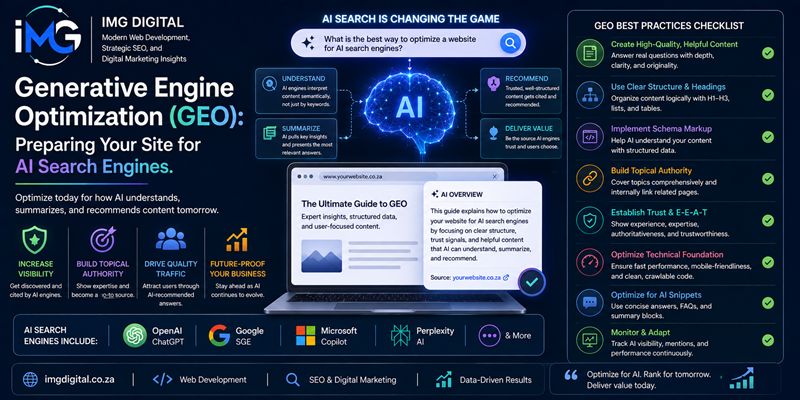
Generative Engine Optimization (GEO): Preparing Your Site for AI Search Engines – Search engines are undergoing their most significant evolution in decades. In the past, traditional search engines operated primarily as indexing systems that directed users to a list of ten blue links. However, the rapid emergence of artificial intelligence has introduced conversational search engines that synthesize comprehensive answers directly.
Generative Engine Optimization (GEO): Preparing Your Site for AI Search Engines
As a result, traditional Search Engine Optimization (SEO) is expanding into Generative Engine Optimization (GEO). Specifically, GEO focuses on optimizing digital content so AI models like Google Gemini, ChatGPT, and Perplexity can accurately extract, cite, and recommend your platform. Therefore, understanding GEO strategies is essential for maintaining online visibility within an AI-first web ecosystem.
Understanding the Evolution from SEO to Generative Engine Optimization
Traditional SEO relies heavily on keyword placement, backlinks, and document hierarchy to rank individual web pages. Conversely, generative search engines evaluate entity relationships, semantic clarity, and topical authority to construct synthesized responses. When a user submits a complex query to an AI engine, the system does not simply retrieve matching web pages. Instead, it analyzes hundreds of authoritative sources, extracts verified facts, and generates a unified response.
Consequently, websites that fail to present clear, structured, and fact-based information risk being excluded from AI-generated overviews. Furthermore, generative search models prioritize content that demonstrates high trust and domain expertise. Therefore, digital businesses must adapt their content architecture to align with how Large Language Models (LLMs) process, interpret, and cite information across the web.
Strategic Pillars for Optimizing Content for AI Search Engines
Ensuring your platform becomes a primary citation source for AI search engines requires combining technical precision with authoritative content creation. Below, three essential strategic pillars illustrate how to optimize web applications for generative engines.
1. Authoritative Citations and Statistical Data
AI models strongly prefer content backed by verified data points, quantitative research, and direct expert quotes. For instance, including precise statistics and citing primary industry sources increases the likelihood of an AI engine referencing your domain. As a result, articles containing verifiable facts earn higher trust scores within generative synthesis pipelines. In addition, avoiding vague claims ensures search algorithms perceive your content as reliable.
2. Clear Summary Statements and Direct Answers
Generative models excel at summarizing complex subjects for human readers. If your content buries key insights under repetitive introductory text, AI crawlers may pass over your page entirely. Conversely, structuring sections with immediate, definitive summary sentences allows AI tools to extract key takeaways effortlessly. Furthermore, utilizing clear Question-and-Answer (Q&A) formats and structured bullet points enhances content readability for both human visitors and machine algorithms.
3. Robust Schema Markup and Semantic HTML
While natural language processing handles raw text, structured data provides unambiguous machine context. By implementing Schema.org JSON-LD scripts, developers define explicit entities, organizational credentials, and content relationships directly in code. Consequently, AI models parse your business context without misinterpretation, leading to accurate brand citations within AI overviews. How to Conduct a Comprehensive Technical SEO Audit on Legacy Websites
Expanding Your Entity Footprint Beyond Your Main Domain
Generative AI models do not evaluate your website in complete isolation. Instead, LLMs scan the broader web ecosystem to verify your brand’s overall entity authority. Specifically, brand mentions across reputable news portals, digital directories, and industry publications reinforce your domain’s credibility. When an AI model encounters consistent entity information across multiple authoritative sources, its confidence score for your platform increases significantly. As a result, your domain becomes the preferred citation source when AI engines synthesize industry-specific recommendations. Therefore, maintaining a strong, consistent digital presence across external authoritative platforms is a vital requirement for successful GEO.
Summary
In conclusion, Generative Engine Optimization represents the next frontier of digital marketing and technical web design. By incorporating authoritative data points, structuring clear direct answers, and implementing comprehensive JSON-LD schema markup, web platforms adapt seamlessly to AI-driven search environments. Furthermore, establishing a consistent entity footprint across external digital channels reinforces long-term domain credibility. Ultimately, adopting GEO best practices guarantees that your website remains visible, authoritative, and competitive as modern search technology continues to evolve.