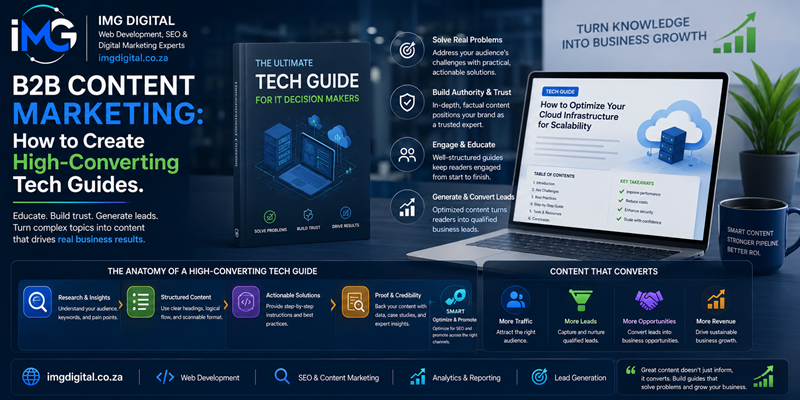
B2B Content Marketing: How to Create High-Converting Tech Guides – Enterprise sales cycles in the technology sector are notoriously complex, lengthy, and multi-layered. In the past, B2B organizations relied on traditional sales pitches, product brochures, and cold calling to secure prospective clients. However, modern enterprise buyers conduct extensive independent research long before contacting a sales representative.
B2B Content Marketing: How to Create High-Converting Tech Guides
Specifically, Chief Technology Officers (CTOs), IT directors, and software architects evaluate technical solutions based on educational depth, architectural reliability, and clear business value. As a result, traditional promotional marketing often fails to engage sophisticated B2B buyers. Instead, implementing strategic B2B content marketing centered around high-converting technical guides has emerged as the premier strategy for driving qualified enterprise leads. Therefore, this comprehensive guide explores how digital organizations can engineer technical documentation that educates decision-makers and accelerates conversion pipelines.
Understanding B2B Buyer Intent and Persona Needs
To craft high-converting technical content, content strategists must understand the distinct motivations of different enterprise stakeholders. Unlike consumer purchasing decisions, which are often driven by immediate emotional triggers, B2B technology acquisitions involve significant financial investment and operational risk. When evaluating software platforms, cloud infrastructure, or digital services, enterprise buying committees typically consist of two distinct buyer personas.
First, technical evaluators—such as lead developers and IT architects—scrutinize technical specifications, security protocols, API capabilities, and implementation friction. Second, executive stakeholders—such as Chief Information Officers (CIOs) and financial officers—focus on long-term cost efficiency, scalability, and risk mitigation.
Consequently, high-converting tech guides must address both technical feasibility and business impact simultaneously. By providing clear architectural frameworks alongside executive summaries, your content satisfies the requirements of every decision-maker in the buying committee.
Core Structural Elements of High-Converting Tech Guides
Converting technical readers into enterprise leads requires structuring documentation for clarity, authority, and immediate value delivery. Below, three critical structural strategies demonstrate how to optimize technical guides for maximum conversion.
1. Lead with High-Density Executive Summaries
Technical decision-makers are exceptionally busy and prioritize immediate clarity. If a tech guide buries its core insights beneath extensive fluff, readers abandon the document quickly. Therefore, every technical guide should open with an executive summary outlining key takeaways, implementation prerequisites, and business outcomes. As a result, readers grasp the practical value of your guide immediately.
2. Provide Practical Workflows and Implementable Architecture
Abstract concepts rarely convince technical buyers to adopt new solutions. Instead, content creators must offer step-by-step implementation frameworks, code snippets, or architectural blueprints. For example, rather than simply describing web security concepts, provide concrete code examples demonstrating input sanitization or OAuth implementation. Consequently, prospective clients recognize your organization as an authoritative domain expert.
3. Integrate Empirical Data and Case Study Validation
Claims made without evidence erode brand trust during enterprise evaluations. By incorporating real-world benchmarks, performance testing metrics, and client case studies, you validate your technical claims empirically. Furthermore, citing primary data sources and industry benchmarks strengthens domain credibility, encouraging readers to engage further with your technical team. Building a Personal Brand in Tech: Digital Marketing Strategies for Developers
Strategic Lead Capture and Call-to-Action Integration
Creating exceptional technical content represents only half of the B2B content marketing equation. To drive business growth, tech guides must convert passive readers into active sales pipeline opportunities.
| Content Gating Strategy | Primary Implementation | Target Business Objective |
| Fully Ungated Content | Open HTML articles with inline CTAs | Maximizing organic search reach & brand authority |
| Hybrid Gated Content | Free article access with downloadable PDF | Balancing SEO visibility with direct lead capture |
| Fully Gated Assets | Form submission required for access | Capturing high-intent enterprise contact details |
While fully gating content generates direct contact lists, it severely restricts organic search engine discoverability. Conversely, leaving content completely ungated can limit direct lead collection. Therefore, deploying a hybrid model yields optimal results. Specifically, publish full-text guides on searchable web pages while offering enhanced downloadable PDF resources—such as implementation templates or code repositories—in exchange for contact details. In addition, place contextual Calls-to-Action (CTAs) within the article text, inviting readers to schedule technical consultations or request custom platform demos.
Optimizing Technical Content for Search and Distribution
A tech guide can only convert buyers if it reaches the appropriate audience. Therefore, technical teams must optimize guides for search engine crawlers and professional distribution networks.
Specifically, apply semantic SEO practices by incorporating relevant technical entities, structured Schema markup, and clear heading hierarchies. Furthermore, distribute guides across developer communities, LinkedIn industry networks, and technical email newsletters. As a result, your technical guide establishes broad visibility among key industry decision-makers, driving sustained organic traffic and qualified enterprise leads.
In conclusion, synthesizing B2B content marketing into a high-converting pipeline demands a disciplined commitment to educational quality, technical accuracy, and strategic conversion design. By structuring deep technical insights, providing practical implementation frameworks, and deploying balanced lead-capture strategies, technology organizations build profound domain trust.
Furthermore, educating prospective buyers before asking for a sale shortens enterprise procurement cycles significantly. Ultimately, mastering the art of high-converting technical guides ensures your digital brand establishes market leadership and achieves sustainable revenue growth across modern B2B landscapes.