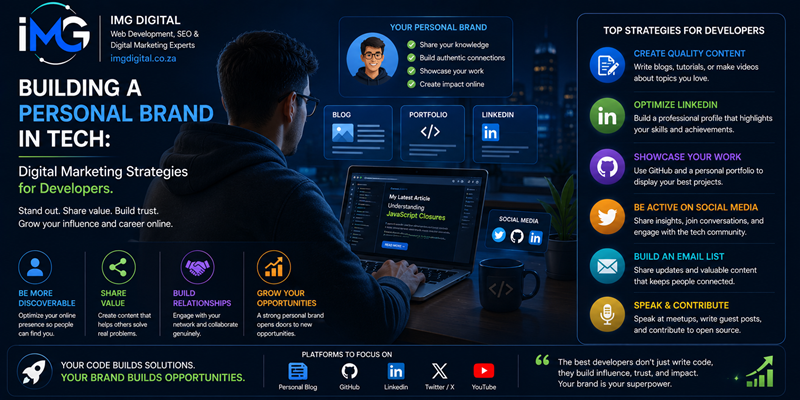
Building a Personal Brand in Tech: Digital Marketing Strategies for Developers – The technology industry is exceptionally competitive and constantly evolving. In the past, software developers relied solely on traditional technical resumes and code repositories to secure high-value employment opportunities. However, technical competence alone is no longer sufficient in a crowded global talent market.
Building a Personal Brand in Tech: Digital Marketing Strategies for Developers
As a result, building a personal brand has become a critical career accelerator for software engineers, system architects, and digital consultants. Specifically, personal branding applies proven digital marketing strategies—such as content creation, search engine optimization, and social proof—to showcase individual expertise effectively. Therefore, this comprehensive guide explores actionable strategies developers can deploy to build a compelling personal brand in tech.
Defining Your Technical Niche and Value Proposition
Before launching marketing initiatives, developers must define their core positioning clearly. If you try to position yourself as an expert in every technology stack, your brand identity becomes diluted and unmemorable. Instead, focus on a specific technical niche, such as full-stack web engineering, cloud security, or mobile UI performance optimization.
Furthermore, establish a clear unique value proposition (UVP). For example, your UVP might highlight your ability to bridge business requirements with scalable backend microservices architecture. Consequently, prospective clients, engineering managers, and enterprise employers recognize your specialized value immediately. Therefore, aligning your skill set with a distinct technical niche forms the foundation of a recognizable personal brand.
Content Marketing Strategies for Software Engineers
Publishing educational content demonstrates domain authority far more effectively than self-proclaimed resume claims. By sharing problem-solving insights, engineers build trust within the broader developer community.
1. Technical Blogging and In-Depth Case Studies
Writing technical articles allows engineers to document their learning journeys and complex architectural decisions. Specifically, focus on writing breakdown guides for real-world engineering challenges. For instance, detailing how you resolved a complex database query latency issue provides tangible proof of your problem-solving capabilities. As a result, readers view your content as a reliable industry resource.
2. Open-Source Contributions and GitHub Portfolio
In addition to writing, active code contributions reinforce your professional credibility. Because public code repositories showcase clean coding habits, documentation skills, and collaborative workflows, maintaining an active GitHub profile acts as a living resume. Consequently, contributing to open-source projects exposes your work to global engineering teams while expanding your professional network.
Leveraging Social Platforms and Technical Communities
Creating high-quality content represents only half of the personal branding equation. To maximize reach, developers must distribute their work across targeted digital platforms strategically.
-
Optimize Professional Networks: Maintain an up-to-date LinkedIn profile featuring a compelling headline, structured summary, and project media links. Specifically, share short technical insights and code updates regularly to stay visible across professional networks.
-
Engage in Developer Communities: In addition, participate actively in specialized platforms like Stack Overflow, Dev.to, Hashnode, and Reddit tech subreddits. By answering technical questions thoughtfully, you build authority and earn community recognition.
-
Publish Original Technical Insights: Furthermore, repurpose long-form blog articles into concise social posts or technical newsletter summaries. As a result, your brand presence expands across multiple digital touchpoints effortlessly.
Optimizing Personal Web Portfolios for Search Engines
Relying exclusively on third-party platforms creates long-term platform dependency risks. Therefore, every software developer should own a personal domain acting as their central digital headquarters.
When constructing your personal website, apply technical SEO best practices. Specifically, optimize page loading speeds, implement mobile-responsive layouts, and use structured Schema markup for your author profile. In addition, target relevant long-tail search terms related to your engineering specialty, such as “Senior React Developer in Cape Town.” Consequently, your website ranks higher when prospective recruiters or enterprise clients search for specialized talent. Ultimately, an optimized web portfolio provides complete control over your personal brand narrative.
Summary
In conclusion, building a personal brand in tech is an essential requirement for long-term career growth, client acquisition, and professional distinction. By defining a clear technical niche, publishing educational content, maintaining active open-source contributions, and optimizing personal web portfolios GAME JUDI SLOT 888, developers establish lasting industry authority. Furthermore, applying structured digital marketing principles ensures your technical expertise reaches global opportunities. Ultimately, investing in your personal brand transforms your engineering skills into a powerful, recognizable asset across modern software landscapes.